Top Fuel Dragster evolution. Morphing Top Fuel and F1 (10 Viewers)

I would imagine that some cutting edge body work for the sake of more aerodynamic efficiency and downforce on a dragster would cost less than a complete funny car body, just guessing.

Joe Amato did it years ago and it never caught on for some reason, I do remember when he debuted it Kenny Bernstein said Great just what we need is to spend more money
 
Joe Amato did it years ago and it never caught on for some reason, I do remember when he debuted it Kenny Bernstein said Great just what we need is to spend more money
I remember that, and the Batmobile. If it worked and the car ran noticeably faster they would do whatever needs to be done to win at that level if NHRA let them I'm guessing.
 
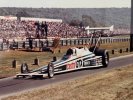
Y'all remember this? I believe it was engineered by some notable IndyCar people. Good in theory, but had some fatal flaws.
 

Attachments

  • Ormsby Aero.jpg
    Ormsby Aero.jpg
    43.4 KB · Views: 33
Joe Amato did it years ago and it never caught on for some reason, I do remember when he debuted it Kenny Bernstein said Great just what we need is to spend more money
I remember that, and the Batmobile. If it worked and the car ran noticeably faster they would do whatever needs to be done to win at that level if NHRA let them I'm guessing.
Y'all remember this? I believe it was engineered by some notable IndyCar people. Good in theory, but had some fatal flaws.
I think that with today's composite materials it would be a lot lighter.
 
I remember that, and the Batmobile. If it worked and the car ran noticeably faster they would do whatever needs to be done to win at that level if NHRA let them I'm guessing.

I think that with today's composite materials it would be a lot lighter.
The Ormsby streamliner was in fact carbon fiber/kevlar composite. Pretty $$ for that time I imagine.
 
The Ormsby streamliner was in fact carbon fiber/kevlar composite. Pretty $$ for that time I imagine.
I at least appreciate the desire to go faster and be more efficient through the air. All it takes is one group of people to try one thing that works, and then poof. Kinda like the Amato tall rear wing if I am not mistaken. How long did it take for everyone to have one when it showed a performance advantage? No comparison in cost and development, but when it showed it was better it became the standard quickly
 
i think the tall wing w/amato was '86? and frank went to 300" in '88, after that we've watched subtle refinements,
including the implementation of, and 35 years later the removal of the mudflaps. when langdon went 345, who'd ever think
part of that was possibly from the removal of a thought to be aero piece.
 
Last edited:
A great quote from Gary Ormsby after abandoning the streamliner concept. Amen, lol.
"We tried and learned that aerodynamic things that should work, according to theory and computer findings, don’t necessarily work on these dragsters,: he said. "The fastest and quickest cars are conventional dragsters. The bottom line is that drag racing is a horsepower sport. What really makes these cars go in that piece of aluminum between the framerails. Unlike IndyCar racing, where there is a smooth transition to high speeds, drag racing is a sport of such violent horsepower that many aerodynamic techniques do not apply. Aerodynamics still play a role, but not as much as pure horsepower.
 
i think the tall wing w/amato was '86? and frank went to 300" in '88, after that we've watched subtle refinements,
including the implementation of, and 35 years later the removal of the mudflaps. when langdon went 345, who'd ever think
part of that was possibly from the removal of a thought to be aero piece.
Well less drag means more speed. The mudflaps could be a much better and more efficient design. When you look at aero on an F1 car or an Indy car they are elegant, smooth, and just by looking at them you can see why they work. The mudflaps on a Top Fuel Dragster look like a very small brick wall. Maybe all the rich team owners can get together to work on Top Fuel 2.0, get it a wind tunnel and learn from what the F1 guys and the Indy car guys have already spent millions on. Maybe even ask for F1 and Indy Car involvement in the new design? Again, I'm just a fan who wants to see the sport and performance grow.
 
A great quote from Gary Ormsby after abandoning the streamliner concept. Amen, lol.
"We tried and learned that aerodynamic things that should work, according to theory and computer findings, don’t necessarily work on these dragsters,: he said. "The fastest and quickest cars are conventional dragsters. The bottom line is that drag racing is a horsepower sport. What really makes these cars go in that piece of aluminum between the framerails. Unlike IndyCar racing, where there is a smooth transition to high speeds, drag racing is a sport of such violent horsepower that many aerodynamic techniques do not apply. Aerodynamics still play a role, but not as much as pure horsepower.
I get his perspective, may he rest in peace....
 
we have watched the mono element rear wing tried. i thought it would work in TF, and we still see it today in sportsman classes.
we have watched the rear element on FC's go from almost a vertical piece across the deck lid, to the addition of two spill plates,
creating three bays that are individually adjustable. we have seen the front wing morph into what we see today. the TF injector grow tall
as apposed to the old style. paul romine installed vortices once, they were quickly ruled out. the enclosed canopy underwent scrutiny
until allowed. there used to be an L shaped port on nose of TF'rs, now i believe the air enters tube under front wing?
FC body development in wind tunnel with wider front, and ugly 'greenhouse' we now see, instead of early 90's when canopy posts came
down flush with side of body ...... i'm ok with small adjustments. i hope we see a few more in coming years.
 
i think the tall wing w/amato was '86? and frank went to 300" in '88, after that we've watched subtle refinements,
including the implementation of, and 35 years later the removal of the mudflaps. when langdon went 345, who'd ever think
part of that was possibly from the removal of a thought to be aero piece.
1984 Gainesville Amato debuted the big wing and broke the 260-mph barrier, along with Kenny Bernstein in his Funny Car.
 
The pic is interesting, but the specs won't work.
In particular the downforce. If it only creates 3000 lbs. of downforce at 330 mph, it will smoke the tires at 330' every single run.

Also the wheelbase (not mentioned in the specs) looks very short, the flexing of the chassis is needed to get the car moving. A short stiff chassis will not work.

Alan
Just don't tell that to Diamond Dave Miller! Just poking fun at ya Alan :D I know you know about this car...

Obviously, had this concept worked it would have become the way forward. But it didn't - for the reasons Alan points out. I was fortunate enough to see this car run at Indy in '85 and while it ran respectably, it was not really competitive. But you have to admire the guy for trying something different!

miller-hero.jpg
 
Last edited:
The front wings on todays T/F are bigger than the rear wing back in the 70's. Garlits had a mono wing car that worked, Bruce Larson drove it for awhile. Very competitive. Just to throw out something, the Hemi OHV engine is the only one allowed. No DOHC, etc. An interesting concept was T/F dragster with 1000 CI, DOHC, twin monster turbos (or even 4 turbos), alky. Idea was that the engine could make close to what the nitro engine is today. I have watched a Pro Mod door car run a 5.14 ET (outlaw), so the power could be there to run with the nitro cars, IF NHRA would allow it. Just thinking kinda out of the box. How many remember Prudhomme's wedge car? Was about 200 lbs overweight, but I saw that car run 6.43 - 234 at OCIR around 1972 (?). Would a wedge car work today with a bigger design?

 
Anyone here an archer?

Accuracy and speed on something as rudimentary as a device going from Point A to Point B- in a straight line- does not necessarily mean adding MORE stuff to it.

TF aero is mastering control with as little as possible to do it with. Pulling off the mudflaps is a textbook example of that.
 
Anyone here an archer?

Accuracy and speed on something as rudimentary as a device going from Point A to Point B- in a straight line- does not necessarily mean adding MORE stuff to it.

TF aero is mastering control with as little as possible to do it with. Pulling off the mudflaps is a textbook example of that.

Downforce increases HP needed exponentially, the reason PS runs as close to zero as possible.
 
Anyone here an archer?

Accuracy and speed on something as rudimentary as a device going from Point A to Point B- in a straight line- does not necessarily mean adding MORE stuff to it.

TF aero is mastering control with as little as possible to do it with. Pulling off the mudflaps is a textbook example of that.
That is a very valid point, but the challenge goes beyond aerodynamics and simply reducing resistance through the air. A Top Fuel car requires thousands of pounds of downforce to keep it planted on the track, keep rear-tire traction through the entire run and to do everything to prevent the tires from smoking from half-track on.

The purpose of this exercise was to explore whether it might be possible to preserve the enormous amount of downforce needed to handle what is likely more than 12,000 horsepower at the rear wheels while reducing drag as much as possible. Reduction of drag equals faster speeds and quicker ET's.

I believe the aerodynamic developments seen in Formula 1, IndyCar, and other forms of motorsport could only benefit Top Fuel. Applying some of those ideas could create a better balance between downforce, drag reduction, high-speed stability, and overall safety.

Again, I am simply a fan who would love to see more innovation, development, and technical advancement in our sport.
 
The front wings on todays T/F are bigger than the rear wing back in the 70's. Garlits had a mono wing car that worked, Bruce Larson drove it for awhile. Very competitive. Just to throw out something, the Hemi OHV engine is the only one allowed. No DOHC, etc. An interesting concept was T/F dragster with 1000 CI, DOHC, twin monster turbos (or even 4 turbos), alky. Idea was that the engine could make close to what the nitro engine is today. I have watched a Pro Mod door car run a 5.14 ET (outlaw), so the power could be there to run with the nitro cars, IF NHRA would allow it. Just thinking kinda out of the box. How many remember Prudhomme's wedge car? Was about 200 lbs overweight, but I saw that car run 6.43 - 234 at OCIR around 1972 (?). Would a wedge car work today with a bigger design?
Anyone remember the McGee (not sure if I'm spelling it right) quad-cam Top Fuel car that Grubby used to drive? That engine sounded completely different from a Hemi. The ground literally shook when that car did a burnout and made a run. You could even tell from the pits or the parking lot at Pomona when it was on the track. It was amazing.

That's the kind of development I'd love to see again. I could be wrong, but I remember hearing that one of the biggest issues back then was that the fuel pumps just weren't big enough or capable of feeding a beast of an engine like that. With 21st-century technology, today's fuel pumps, ignition systems, and materials, I can't help but wonder if an engine like that would work a whole lot better than it did back then.
 

Users who are viewing this thread

Back
Top